

PAL REPORT APRIL 2026 Gary Cumberbatch
Summary
I was the leader for this trip and was privileged to have such a strong team. It was Antoinette’s last visit and her great organisational skills and knowledge of the Lira staff really facilitated what I believe was a very productive trip. Chloe engaged the ED staff so well that they accepted our proposed changes with enthusiasm, and she helped me develop a new Trauma Course delivered in just 4 hours. Julia was full of energy and never fatigued, She helped prepare several formal teaching sessions and delivered them really well. Along with Antoinette, they trained countless students and midwives on the resuscitation of the newborn including training 2 local trainers to continue their good work. It was Alice’s first time and she was a huge asset especially being the only nurse on the team which made the teaching to nursing staff and students more credible. She was able to split herself between the Paediatric/ neonatal units and ED to support myself and Chloe. We all considered Arnold an integral part of our team and what a hero he was. As usual he took us everywhere and helped us with everything from printing and laminating to contacting the Ultrasound Department to help me get a portable machine. We felt safe throughout the whole trip because of his knowledge of the area.
The hotel staff were excellent and willing to cater for all our needs and provided varied and appetising breakfasts and evening meals.
We tried to visit either the hospital or the University for a day, to reduce the amount of time travelling between the two and found this to be quite effective. We also managed to meet with SICRA (Strengthening Institutional Capacity for Research Administration) whose headquarters were interestingly in an inpatient Psychiatric Unit and it was really interesting to hear about the research projects they were developing- mainly infectious disease. On the last day we had the privilege of touring the Otino Waa Orphanage where we were able to drop off children’s items we had brought.
My objectives prior to visit
- To try and implement the use of a patient whiteboard in ED to identify patients
- Label ED bays
- Determine the need for Radiology input on future visits
- Discover if bedside ultrasound would be valuable to ED staff and if so, to commence teaching
- Lead a team effectively
Chronology of events
We received a great welcome form the staff at both the University and the Referral Hospital on the first day and we were able to identify the areas they wished us to teach. Joel Lec had printed out a list of the different nursing/midwifery student groups and what they wished us to teach which was a great start. Joel had also arranged for us to meet the Dean and Associate Dean of the Medical School and they too were very happy for us to teach their students who were placed on both sites. They informed us that there would also be medical students from Kampala.
We then proceeded to create a timetable for the 2 weeks and put detail to this as we went along. Chloe designed this and formed a link so that we could each add to this timetable as we got commitments from various groups. As we met students, interns and residents we managed to obtain their personal contact details which we then used to confirm dates of our teaching and asked them to encourage their peers to attend. This was very successful with the Trauma Course we held as we managed to get 34 attendees.
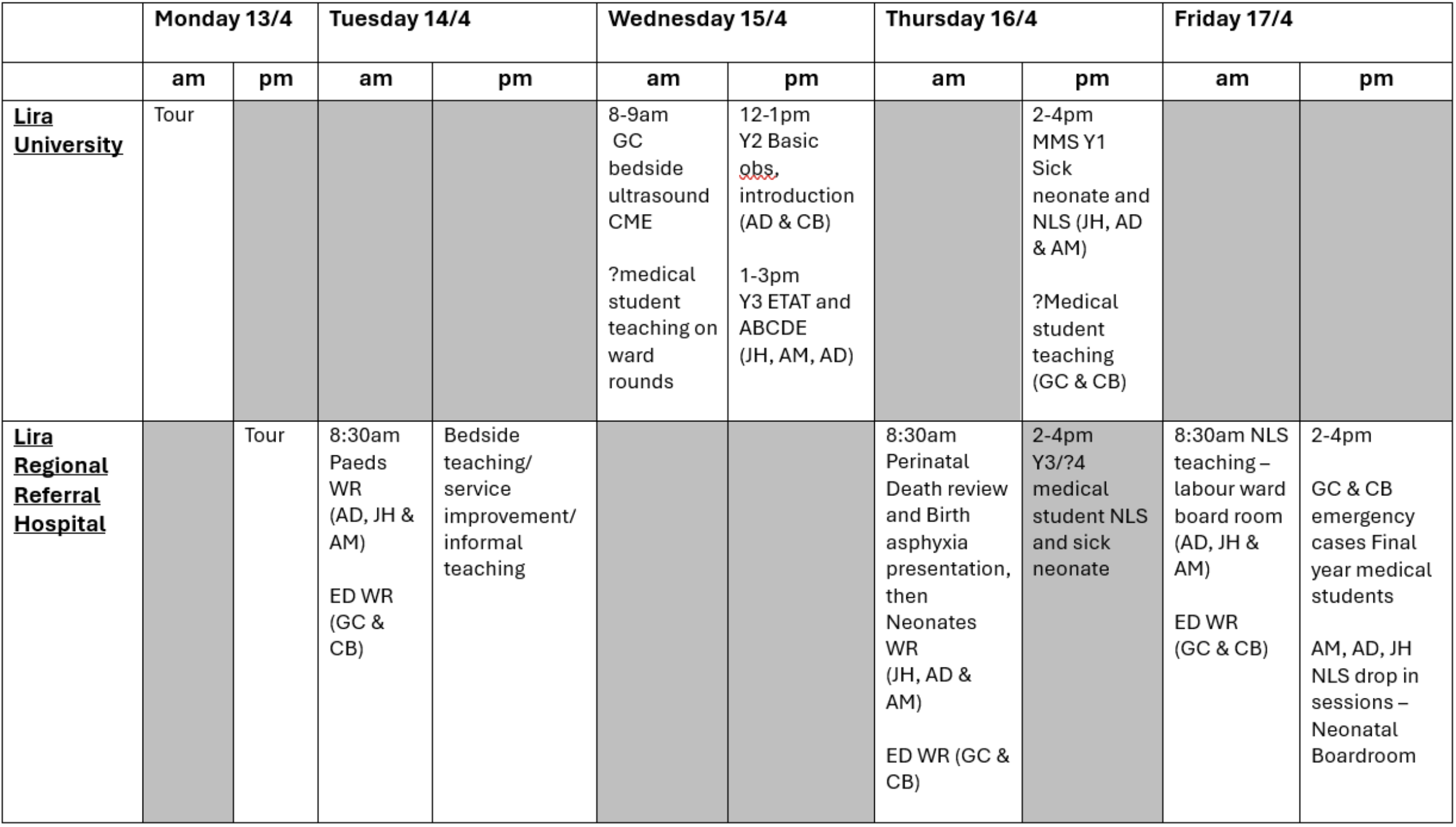
Timetable for Week 2
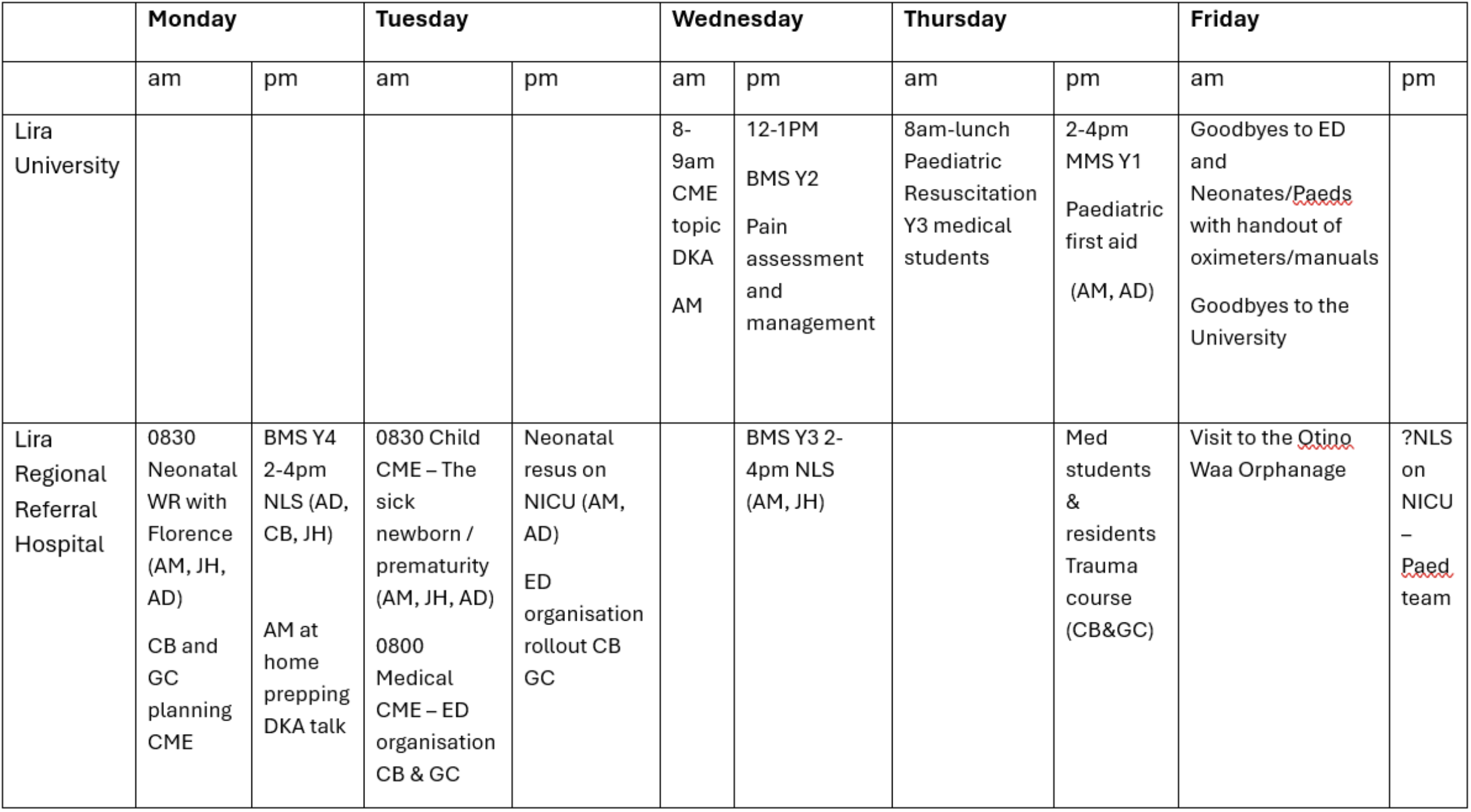
Achievements at LIRA university
- We taught at their formal CME meetings which are every Wednesday morning and includes Consultants, residents, interns and medical students
- Antoinette, Julia and Alice attended Paediatric ward rounds
- In the Clinical Skills lab- several teaching sessions were done including ETAT, assessment of the sick child and scenario based teaching
Achievements at LRRH
- Labelling of the 18 ED bays using previously bought medical labels
- The ED patient whiteboard identified the patients in each bay and treatment plans were written next to their names so all staff knew what outstanding tasks were needed. This was maintained by the nursing team who felt it had already improved the LOS of their pts
- Support of the interns in ED and on the Paediatric ward as senior medical presence was short and sporadic
- Multiple teaching sessions on the management of the newborn in line with the “Help Babies Breathe” national policy
- Training of local midwives to continue this teaching as there was a huge demand
- Delivery of a new Trauma Course which was entirely scenario-based with breakdown into smaller groups – formal feedback was very encouraging
Identified needs of LIRA University for possible future development
- They need an echocardiography machine as the one they have generates very poor images and they have abandoned its use there, despite having a sonographer
Identified needs of LRRH for possible future development
- Radiology input would be very valuable as the CT scans that are done for ED (and I suspect for the wards too) are not reported and the interns expected to look at the minute hard copies and interpret them. This would potentially also extend to training ED senior staff in bedside USS as many patients were too unstable to move to the Radiology suite. It would be even better to help them devise a process whereby scanning could be collocated to ED.
- There were only 2 sharps bins in ED and with the number of cannulations that occur along with the prevalence of HIV, providing more bins would help reduce risk. This may well be an issue on the wards as well.
- There were only 2 monitors in ED and these were continually in use and looked like they were on their last legs. It would be really useful if they could have more and this would certainly improve the number of observations patients would get.
- To train local doctors to teach the Trauma Course. Trauma patients were commonly seen and one night 27 patients were brought in following the rollover of a huge truck carrying market vendors! We found one of the ED nurses who looked after their defibrillator monitors to be so good that he taught with us on the Trauma course.
- We provided the first piece of equipment ( a defibrillator/monitor) for the LRRH new Simulation room which is in their new building: The Ambulance Dispatch Centre
Suggestions in Preparation for future teams’ visits
- Include their own staff as teachers- after using James Peter to teach on our course it became very apparent to us that this should be something we actively seek to achieve on each visit. I would suggest that we try and find contacts in the areas in which we wish to teach and bring them into the teaching. This may well begin with them observing the first few sessions and then taking part.
- Joel Lec is happy to provide a list of the different student groups at the University
- With more rooms now available at LRRH in the Ambulance Dispatch Centre, teams can contact Dr Frednald Byamugisha who facilitated the Trauma Course there and potentially book these rooms in advance.
- As their Simulation room is new, it would be useful for teams to take over manikins and resuscitation equipment to be specifically used there. This will make it easier for visiting teams to not need take over such kit each time. Frednald would be really grateful if we could support this.
- To consider using a morning or afternoon at the hotel purely to prepare topics rather than doing this late into the evenings. This enabled us to remain refreshed throughout the 2 weeks.
- Be aware that the IT Department which is adjacent to the LRRH Boardroom can provide you with a WiFi password which was really useful to have.
- We used eSims on our own phones thereby removing the need for local phones to communicate with each other and Arnold. However it didn’t work in all areas of the hospital hence the need to use to WiFi
- Be mindful of what is currently in the 2 suitcases in Lira to reduce taking things that already there eg antibiotics, PEP
Reflections
On my last visit , I had been overwhelmed with the number of patients who were seriously ill and injured in ED and whilst that remained the case this time, I felt better prepared psychologically. I think this allowed me to focus on setting up the patient whiteboard and the labelling of bays to help identify patients and their needs. I managed to get less involved with individual patients and enjoyed advising the interns on what thy might do for their patients.
I enjoyed joining the few ward rounds that did occur and learnt a lot from them especially as they were reviewing patients with malaria and sickle cell disease. I think one of my highlights, and there were many, was watching James Peter deliver his talk on airway management. I was really impressed with his communication style and engagement of the audience and made me realise how important it is to get the local clinicians as part of our teaching team and felt this endorsed what we taught.
It was so nice to see the hospital developing with wall-mounted oxygen and a new Dispatch centre with more teaching facilities which made our teaching increasingly applicable.
I was really happy with what we achieved and felt so lucky to have gone with such a strong team and we got on so well with each other. I had also forgotten how grateful the patients and staff are for us being there and how much they valued what we were doing with them which made it particularly rewarding- thank you for having us Lira.