

October ’24 iAIMS Report
UK iAIMS Team for the trip:
Dr Pasco Hearn – Infectious Diseases & Microbiology trained Consultant Microbiologist
Lindsey Osbourne – Senior Biomedical Scientist at UHD
Dr Louise Roper – Principal Health Psychologist, Liverpool Heart and Chest Hospital, Lecturer at University of Liverpool and linked with ‘Change Exchange’.
Emily Seddon – Mental Wellbeing Lead Midwife at UHD
This October we had another very impactful trip to Northern Uganda. My half of the team were delivering work on the iAIMS Project, which focusses on the growing global threat of antimicrobial resistance (AMR).
Background:
iAIMS = integrated Antimicrobial stewardship, Infection prevention & control and Microbiology Services
This is part of CwPAMS2 (Commonwealth Partnerships for Antimicrobial Stewardship), a collaboration between THET (now: Global Health Partnerships) and the CPA (Commonwealth Pharmacists Association). The project works to tackle AMR at the Lira Regional Referral Hospital in Northern Uganda whilst improving knowledge and practice around AMS within NHS and Ugandan healthcare workforce.
Main Project Activities:
This year we built on what was established in the first project visit last year. Three main workstreams exist, each with a Ugandan lead, and the absolutely essential project coordinator, David Oriokot. Local oversight comes from the Ugandan Lead, Dr Francis Kiweewa, along with myself chairing weekly meetings and providing remote oversight from the UK.
Microbiology – Maria Apaki:
• Expansion, closer regulation and quality improvement within Microbiology;
• Monthly lab-clinician engagement meetings; Local antibiogram production;
• Data sharing via WHO NET, contributing to national AMR database;
• Incorporation of antibiogram data as part of pharmacy procurement and local antimicrobial guidelines,
• ensuring availability/selection of most appropriate IV and oral antibiotics;
Antimicrobial Resistance and Stewardship (AMR/AMS) – Harriet Tino:
• Creation of Antimicrobial Guardians to monitor and encourage good AMS practice, answering to the AMS Subcommittee;
• “Training the trainer” workshops in Micro/AMR/AMS/IPC developed and rolled out;
• Subsequent Educational Package repeatedly delivered to hospital healthcare workers and to those of surrounding regional healthcare facilities;
• Data collection, looking at PPS and prescribing behaviour;
• Funding of the AMS stream lead to complete Leadership Fellowship
Infection Prevention and Control (IPC) – Dr Frednald Byamugisha:
• IPC monitoring of Hand Hygiene, environmental cleaning and waste management commenced;
• Creation of IPC Champions to monitor and encourage good IPC practice, feeding into the IPC Subcommittee;
• “Training the trainer” workshops in Micro/AMR/AMS/IPC developed and rolled out;
• Subsequent Educational Package repeatedly delivered to hospital healthcare workers and to those of surrounding regional healthcare facilities;
• Education of patients/carers/family;
• Community engagement using local radio talk shows;
Gender Equality and Social Inclusion (GESI):
• Interviews carried out exploring GESI issues
• Workshop and creation of a GESI Committee, reporting to the Hospital Parliament
• GESI Champions nominated to chair the committee
• Behavioural training, using the COM-B model to inform ongoing action plans, such that activities embed and continue.
The timetable of activities was very full this year as we continued to lead educational meetings, ensured engagements continued throughout the hospital, developed work plans for each work stream above, using the COM-B model for behavioural change and established a committee to progress the work we introduced on tackling issues around Gender and Social Inclusion .
Team 1 – iAIMS Team Schedule:
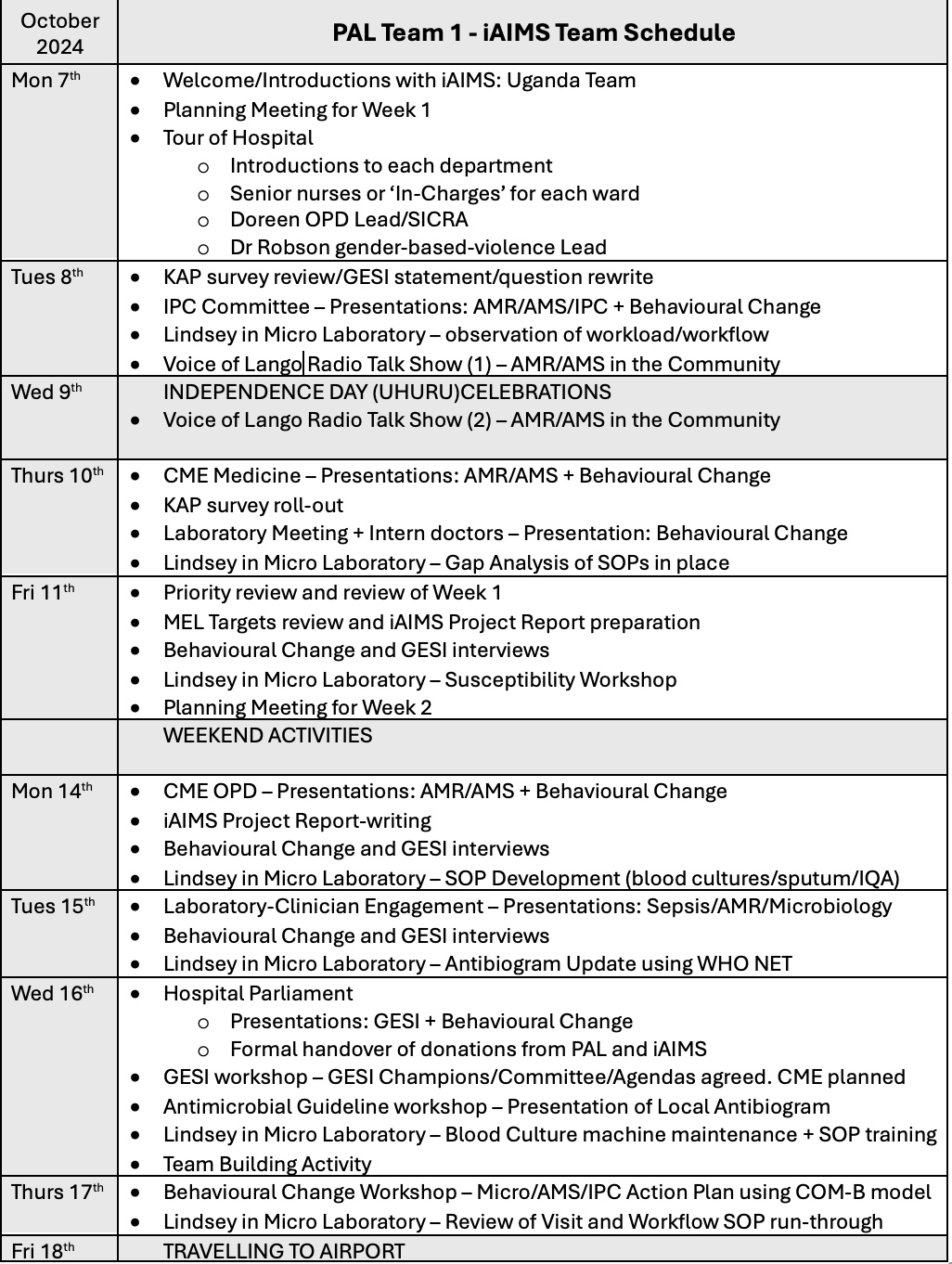
This year we had the huge benefit of Lindsey in the lab, really digging in to the processes there, initially observing and then educating and discussing with the team ways to improve things. She has a vast experience to draw from and was keen to also learn from her time in Uganda. She developed great working relationships very quickly, which allowed our Ugandan colleagues to embrace changes to the way they do things that will improve the quality, consistently and efficiency with which they carry out their work.
GESI work, which was introduced with Emily Seddon last year was again presented to the Hospital Parliament. The topic was further explored this year with a number of interviews being carried out by our health psychologist Louise. This lead to a half day workshop to develop an action plan to help the hospital tackle inequalities in access to healthcare as they relate to gender and social inclusion. GESI Champions were nominated to chair the committee going forwards and their work has since been presented to the Hospital Parliament again, further establishing their ongoing work.
Louise Roper also helped hugely by introducing the COM-B model of behavioural change. Several talks, interview and discussions culminated in a full day workshop considering the wider issues around AMR, listing key behaviours that need to change in order to address the underlying problems that threaten patient safety. This resulted in the production of well-structured and achievable action plans that will really help the teams to achieve the project goals, but also to enable sustainable, locally driven change to take place.
In addition to this, we also had the opportunity to join two local radio talk shows, to publicise the messages around antimicrobial stewardship and the dangers of unchecked antimicrobial use. Antibiotic use in the community and for livestock is a huge issue. On the Voice of Lango radio we talked through these topics and even took phone calls from the listening public.
So, a really successful and impactful second project trip. This will set us up very well as we begin to wrap-up the planned work and reflect on what worked and what could be improved and gear up towards the possibility of extending the project. Fingers crossed that further funding opportunities will come.
As ever, the trip was also a real eye opener. Challenging at times when seeing the reality of such inequality and the nature of healthcare delivery in such a setting. Encouraging to work with so many bright, welcoming and motivated colleagues from Uganda, who are keen to deliver the best quality healthcare that they can. Hugely enjoyable to soak up some history, culture, and natural beauty of the country, which this year included an amazing Independence Day celebration and a chance encounter with a well-fed and sleepy lion who watched us from her perch up a tree!